This has got to be an experience that’s unique to the first world: you walk into a bathroom and your nostrils are hit with the scent of artificial lemon attempting to mask harsh disinfectants that will kill anything and you think “Clean.”
Category: General
-
There’s no shame in walking away
Apparently there’s a growing number of people strategically defaulting on their mortgages. Or, at the very least, there’s a growing fear that this is happening. For some commentators, this is a sign of low moral fiber, that the strategic defaulters are somehow breaking their word, losing their honor, etc.
Bullshit.
Housing loans are not based on the belief that the borrower will pay the money back because his honor is at stake. They are based on a contract, which spells out exactly what the lender can do if the borrower stops paying back the loan. The lender can choose to take the house and sue the borrower for the difference between the house’s value and the loan amount (unless it is a non-recourse loan).
There’s also this refrain of unease that not only is the decision to default immoral, but it’s just too easy and trivial to do. That the borrower somehow escapes punishment-free for buying too much house or getting a terrible loan.
But losing your home and getting sued is not a trivial thing. Not to mention the massive hit your credit score will take. For the borrower who defaults, it means that credit will either be unavailable or offered at exorbitant rates. Moreover, employers and landlords often do credit checks prior to hiring or renting, which will further limit the borrower’s options.
Nor is it necessarily easy! The lender has the option to take the home, but no obligation to do so. If there’s a glut of inventory in a particular submarket, a backlog of defaults to process, etc., the lender can choose to send nasty letters to try to get the borrower to pay, but may hold off on actually seizing the property. In the meantime, the borrower still owns the property and any liabilities that go along with it.
Finally, there are those that mention other effects of the foreclosure, such as declining house values and higher borrowing costs within the submarket or economic cohort. But aren’t these effects the natural outcomes of a market? We are coming off a 7 year bubble; houses are going to go into foreclosure, prices will drop, costs will increase, and to expect anything else is insane.
The bottom line is that the decision to take a loss, just as the decision to purchase, should be evaluated rationally by the individuals involved. There are a lot of things to consider beyond the value of your house, the amount of your loan, your monthly income, and the monthly expenses, but morality is not one of them.
-
But I’m your biggest fan…
I bought all your records, clipped every magazine article, videotaped you on Letterman, saw you play at the Roxy, the El Rey, the Wiltern, and the Bowl. I joined the fan club, wrote you letters, and sent you photos. So why didn’t you talk to me that night at Swingers when I came up to you and Malcolm McDowell in the booth in the back?
Thanks to the “life streaming” phenomenon, every Joe can now feel like a pop star when the quietly obsessive Jane comes up to them and starts talking casually about Joe’s life. As I’ve mentioned before, between your various profiles, blogs, Twitter and photo streams, any idiot who bothered could piece together a well defined picture of your life. Your education, where you were last night, what you ate on Sunday, what you saw on your last vacation, who your friends are, your political views, your favorite liquor, what you bought from Amazon, your hobbies, the name of your cat.
Example 1: Beatles, Yoga, Jon Stewart, New Age, sympathetic, Jewish, born in November, liberal, Democrat, alternative, 80’s, classics, Ivy League, no land-based meat, emotional.
Example 2: Netflix, Tivo, born in December, museums, clubs, drinking, food, web 2.0, fashion, spends time with grandma, owns property in AZ, developer, Lessig, Heroes, Britney, SNL, gay, Jewish, tall, karaoke, make that very gay.
Example 3: food, Blackberry, hospital, County-USC, Democrat, alt/indie music, ninjas, music, Obama, AIDS, food, garage sale, Silver Lake, probably hipster, NPR, WBR, Darfur, ACLU.
Bonus points if you recognize yourself in the examples. 🙂
-
Popular Photos from StudioGlyphic
For some reason, a handful of people on MySpace, blogs, and forums are linking to these two photos:

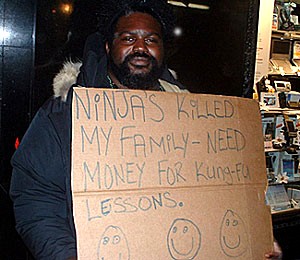
So I might as well, too.
NaBloPoMo 29
-
More freeways is not the answer
Lots of people complain about the congestion here in Los Angeles. When asked what they’d want done, the answer is almost invariably, “They should make more lanes.” Unfortunately, making more lanes doesn’t solve anything. It’s true that adding capacity to the freeway will increase speeds, but increasing speeds and reducing commute times makes people more willing to travel further distances to their places of work, or convinces people who might otherwise avoid peak rush hour to switch back to a normal commuting time. The system soon reaches equilibrium, which is gridlock during periods of peak demand.
The problem here is that direct costs are kept artificially low; you pay nothing out of pocket to get on the freeway (hence the name). With no direct cost, and all other things being equal, demand always increases to meet the supply.
So what is the answer? Well, there are a few possible answers, some of them better than others, but most likely a combination of them all would address the problem.
- Charging direct costs: Charging people by the mile to use the highway, with higher pricing during rush hour, normal pricing during the day, and low or free pricing at night would cause people to make different choices about where they work and live, what time of day they choose to commute, and how they choose to commute. This is more effective than indirect costs such as gasoline or other taxes.
- Dedicated transit rights-of-way: Frequent, round-the-clock trains or buses with rights of way that matched/exceeded the commute time of personal automobiles would also change the equation, while promoting a virtuous cycle of relieving congestion for those drivers who still don’t have a practical alternative to driving. Imagine the persons per mile per hour capacity of a bus or train that had its own dedicated lane.
- Re-zoning major transportation corridors: Los Angeles is full of two to four story low rise buildings along its major thoroughfares. Doubling the allowable square footage and heights, while promoting the mixing of uses, would add much-needed supply to the real estate market (even now it’s a good idea), giving people more choices in terms of where they work and live.
- Increasing indirect costs: Driving behavior actually changed when fuel cost in excess of four dollars a gallon. Keeping prices high would discourage people from taking frivolous trips by car.
- Enforcing the idea that driving is a privilege: There are way too many idiot drivers on the road. A good chunk of them need to be given lifetime bus passes.
I can sense the coming storm of comments.
NaBloPoMo 17